Position is arguably the most important concept in poker. If you could only master one element of the game, position play would deliver the greatest return on your investment. Data collected from millions of online hands consistently shows that players earn the most money from the button and cutoff, while the small blind is the biggest money-losing seat at the table. Understanding why this happens and how to exploit positional advantages will immediately elevate your game.
Why Position Is the Most Important Concept in Poker
When you act after your opponents, you gain a critical information edge. You see what they do before you have to commit chips. This single advantage ripples through every aspect of the game: hand selection, bet sizing, bluff frequency, pot control, and value extraction.
Consider some approximate profit and loss figures compiled from large online databases at six-max tables. The button wins at roughly 25 to 35 big blinds per 100 hands. The cutoff wins at around 10 to 18 big blinds per 100 hands. The hijack roughly breaks even or wins slightly. The small blind loses around 15 to 25 big blinds per 100 hands. The big blind loses around 20 to 30 big blinds per 100 hands, though strong players reduce this loss significantly through solid blind defense.
At a full ring nine-handed table, the pattern is even more pronounced. Early position seats tend to lose or break even because you must play tighter ranges and you spend every post-flop street acting before most of the table. Late position seats print money because you get to act with the most information and the widest profitable ranges.
The takeaway is straightforward: you will make the majority of your profit from late position. The goal of positional play is to play more hands when you have position and fewer hands when you do not.
Complete Breakdown of All Positions at a Full Ring Table
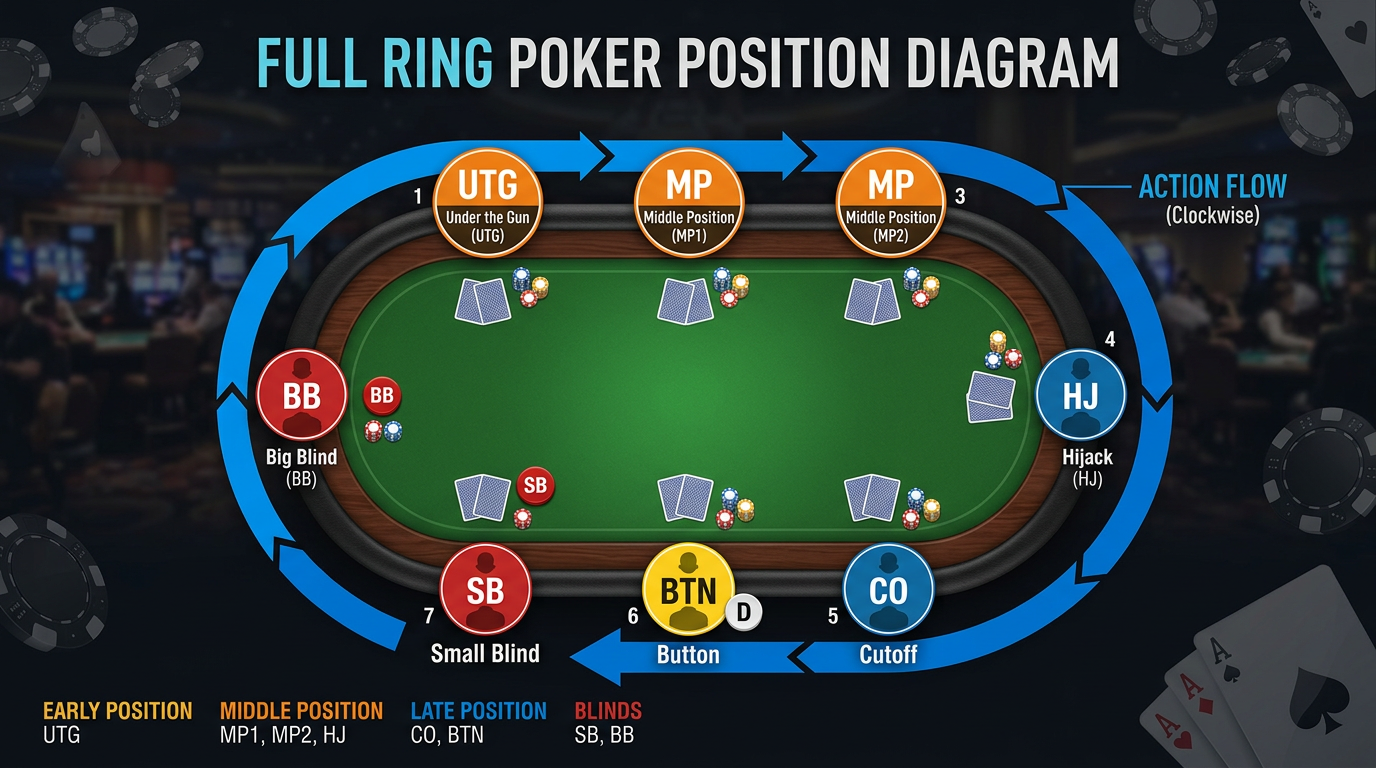
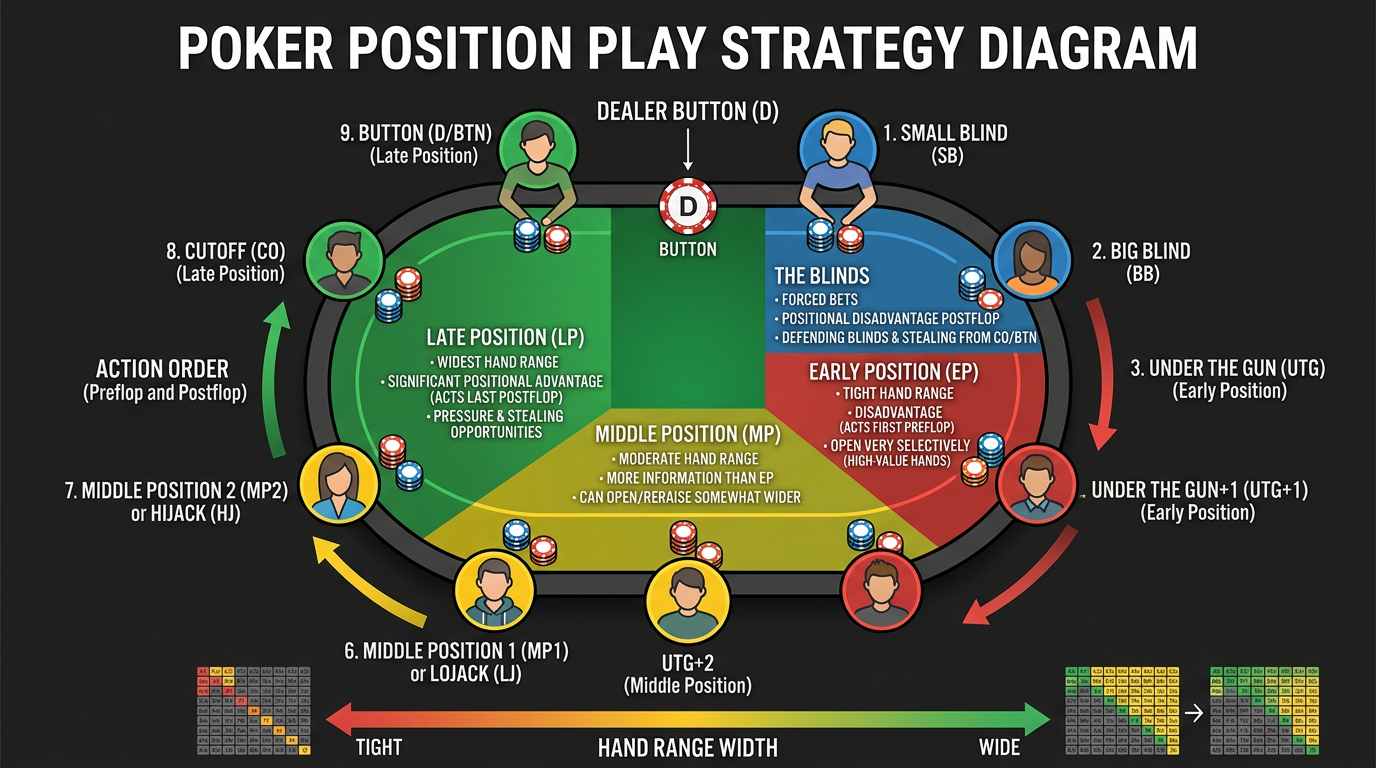
A standard nine-handed or ten-handed Texas Hold’em table has the following positions, listed in order of action preflop (after the blinds post):
Under the Gun (UTG): The first player to act preflop. This is the tightest position because eight or nine players act after you. Any hand you play here must be strong enough to withstand a raise or three-bet from any of those remaining players.
UTG+1 and UTG+2: Still early position seats. You gain a marginal advantage over UTG because one or two fewer players remain to act, but you should still play a conservative range. These seats are sometimes grouped simply as early position.
Middle Position 1 (MP1) and Middle Position 2 (MP2): The transition zone. You can start adding a few more hands to your opening range because fewer players remain behind you, reducing the chance of running into a premium hand. Suited broadway hands and medium pocket pairs become more attractive here.
Hijack (HJ): Two seats to the right of the button. The hijack is where your range starts to widen noticeably. You only have the cutoff, button, and blinds left to act. Many players treat the hijack as the beginning of late position in terms of aggression.
Cutoff (CO): One seat to the right of the button. The cutoff is a highly profitable seat. Only the button and the blinds remain, and if the button folds, you effectively become the last to act post-flop. This is a prime spot for stealing blinds and playing a wide range.
Button (BTN): The most profitable seat at the table. You act last on every post-flop street (flop, turn, and river). This permanent informational advantage allows you to play the widest range of any position, control the size of the pot, and bluff more effectively.
Small Blind (SB): You act second to last preflop but first on every post-flop street. This makes the small blind the worst positional seat at the table. You have already invested half a big blind, creating an awkward situation where you have some pot odds to continue but terrible position for the rest of the hand.
Big Blind (BB): You act last preflop, which is an advantage for seeing a flop cheaply, but first or second on every post-flop street. The big blind loses money over time, but strong players minimize losses through intelligent blind defense and check-raising strategies.
Starting Hand Ranges by Position

One of the most practical applications of positional understanding is adjusting your opening range. Below are approximate ranges for a standard full ring game. These are guidelines for open raising when the action folds to you. Adjust based on table dynamics, player tendencies, and stack depths.
UTG (roughly the top 10 to 12 percent of hands): Pocket pairs TT and above. Suited broadways like AKs, AQs, AJs, and KQs. Offsuit broadways limited to AKo and possibly AQo. This tight range ensures you are rarely dominated and can handle aggression from later positions.
UTG+1 and UTG+2 (roughly 12 to 15 percent): Add pocket nines, suited connectors like JTs and T9s, and AJo. You are still in early position, so discipline matters.
MP1 and MP2 (roughly 15 to 20 percent): Add pocket pairs down to 77, more suited connectors like 98s and 87s, suited aces like A9s and A8s, and offsuit broadways like KJo and QJo.
Hijack (roughly 20 to 25 percent): Add pocket pairs down to 55, suited gappers like J9s and T8s, more suited aces down to A5s (which has straight-making potential), and KTo.
Cutoff (roughly 25 to 35 percent): Add all remaining pocket pairs, all suited aces, most suited connectors down to 54s, and broader offsuit broadways. The cutoff is where you begin stealing aggressively.
Button (roughly 35 to 50 percent or wider): The button can open an extremely wide range. All pocket pairs, all suited aces, all suited connectors, all suited gappers, most broadway combinations, and even hands like K5s or Q8s become profitable opens. The key is that you will always have position post-flop, which makes marginal hands playable.
Small Blind (roughly 30 to 40 percent when open raising): When it folds to you in the small blind, you are heads up against the big blind. You can open wide, but remember you will be out of position for the entire hand. Many players use a smaller raise size from the small blind (2.5x rather than 3x) or even a limping strategy in certain game types.
Big Blind: You do not open from the big blind because you have already posted. Instead, your focus is on defense. Against a min-raise, you are getting excellent pot odds and should defend a wide range, sometimes 40 to 50 percent or more of hands depending on who is raising and from what position.
Example Hands Showing Position Advantage
Example 1: AQ on the Button. You hold AQ offsuit on the button. A player in middle position opens to 3 big blinds. You call. The flop comes K-7-2 rainbow. The original raiser checks. Because you are in position, you recognize that this check likely means they do not have a king. You fire a continuation bet of roughly half the pot. Your opponent folds their pocket fives. Without position, you would have had to act first and would likely have checked, giving your opponent a free card. Position allowed you to identify weakness and take the pot.
Example 2: 88 in Early Position vs. on the Button. You hold pocket eights. The flop comes A-J-5. If you are in early position, you must decide whether to bet into several opponents without knowing their intentions. You likely check, and if someone bets, you face an uncomfortable decision with an underpair. On the button, if everyone checks to you, you can bet for thin value or as a bluff, and you control the action. If someone bets and another calls, you can fold easily, losing nothing extra.
Example 3: Suited Connector on the Cutoff. You hold 8h7h on the cutoff. You open-raise and only the big blind calls. The flop comes Kd-6h-3h. Your opponent checks. You have a flush draw with no made hand. You bet half the pot as a semi-bluff. Your opponent calls. The turn is the 2s. Your opponent checks again. You fire another barrel because your draw still has equity and your opponent’s checking pattern suggests a weak or marginal holding. The river is the Jh, completing your flush. Your opponent checks, you bet for value, and they call with K9. Position allowed you to dictate the aggression on every street while drawing, and you extracted maximum value when you hit.
Positional Stealing: Blind Stealing from CO and BTN
Stealing the blinds is one of the most consistent ways to boost your win rate, and it is most effective from the cutoff and button. When it folds to you in late position, a raise puts pressure on only two or three remaining players who hold random hands.
Recommended open-raise sizes for stealing: From the cutoff, raise to 2.5 big blinds. From the button, raise to 2.2 to 2.5 big blinds. The smaller sizing risks less while accomplishing the same goal of folding out the blinds. If the blinds are tight and folding more than 60 percent of the time, you can profitably open nearly any two cards from the button because the math works in your favor. Even if they call, you still have position for the remainder of the hand.
Watch for opponents who defend their blinds aggressively with three-bets. Against these players, tighten your stealing range slightly and be prepared to four-bet or fold rather than calling out of position.
Post-Flop Positional Advantage
Position does not stop mattering after the flop is dealt. In fact, the post-flop streets are where position delivers the greatest edge.
Information gathering: When you act last, you see your opponent’s action before deciding your own. A check from your opponent might indicate weakness. A bet might indicate strength or a bluff. You get to process this information before committing chips.
Pot control: With a medium-strength hand like top pair with a weak kicker, position allows you to check behind on one street to keep the pot manageable. Out of position, you face the dilemma of betting (and building a pot you might not want) or checking (and giving a free card).
Bluff opportunities: When your opponent checks, you can bluff with the knowledge that they have shown weakness. Out of position, a bluff into an unknown opponent is far riskier. Players who master post-flop positional play often find that many of their bluffs go unchallenged simply because their opponents checked and revealed that they did not connect with the board.
Value extraction: With a strong hand, acting last lets you size your bets based on your opponent’s tendencies. If they check and you believe they have a marginal hand, you can bet smaller to induce a call. If they bet into you, you can raise for maximum value. This flexibility is not available out of position.
Common Positional Mistakes
Playing too many hands from early position. This is the most frequent leak among developing players. Hands like KJo, A9o, and QTs look appealing but are consistently unprofitable from UTG at a full ring table. The math is against you because too many players can wake up with a better hand, and you will be out of position for the entire hand if called.
Not defending the big blind enough. Many players fold too frequently in the big blind, especially against late-position raises. When the button min-raises and you are getting 3.5-to-1 odds, you should be defending with a wide range. Folding too much from the big blind gives your opponents a license to steal relentlessly.
Calling raises out of position. Calling a raise from the small blind or from early position when someone behind you raised is a recipe for losing money. You are building a pot where you will spend every street at an informational disadvantage. Either three-bet to take initiative or fold.
Ignoring position when sizing bets. In position, you can often use smaller bet sizes because you have better control of the hand. Out of position, slightly larger sizes help compensate for your informational disadvantage by charging draws and denying equity.
Practice Exercises
To build positional awareness into your game, try these exercises over your next several sessions:
Exercise 1: Track your win rate by position. Use a tracking program or even a simple spreadsheet. Record how much you win or lose from each seat over 5,000 hands. You should see a clear pattern where the button and cutoff are your most profitable seats. If they are not, revisit your late-position play.
Exercise 2: Fold everything from UTG for one session except premium hands. Restrict yourself to AA, KK, QQ, JJ, TT, AKs, AQs, and AKo from UTG for an entire session. Notice how much smoother your decisions become when you always have a strong hand in early position.
Exercise 3: Open every button when it folds to you. For one session, raise every single hand when it folds to you on the button. Track the results. You will likely find that you win the blinds uncontested a significant percentage of the time, and when called, your positional advantage carries you through many post-flop situations.
Exercise 4: Pay attention to your opponents’ positional tendencies. Note which players open wide from late position and which play the same tight range regardless of seat. Exploit the tight players by stealing their blinds and defend more aggressively against the loose openers.
Mastering position is not about memorizing charts, although starting hand charts are a useful reference. It is about internalizing the principle that acting with information is always better than acting without it. Every decision you make at the poker table should start with the question: what is my position, and how does that affect my strategy?
For more advanced concepts that build on positional play, explore our guide on advanced bluffing techniques, which covers how to leverage positional advantages for multi-street bluffs. If you are new to the game, make sure your bankroll management is solid before moving up in stakes. And check out our player rankings to see how the top professionals consistently exploit positional edges at the highest levels.