Bankroll management is the foundation of a sustainable poker career. Without proper bankroll discipline, even the most skilled players can go broke during inevitable downswings. The concept is simple in theory but demands discipline in practice: maintain a dedicated poker fund that is large enough to absorb the natural swings of the game, and follow strict rules for when to move up, when to move down, and when to stop playing altogether.
What Is a Bankroll and Why It Matters
Your poker bankroll is a dedicated sum of money set aside exclusively for playing poker. This is not your rent money, your grocery budget, or your savings account. It is a separate fund with one purpose: to finance your poker play while protecting you from going broke during losing stretches.
The distinction between bankroll and life money is critical. When players mix the two, bad decisions follow. A player who sits down at a $2/$5 game knowing that a losing session means they cannot pay their electric bill will play scared, make poor decisions, and tilt when they lose. A player with a properly funded bankroll can absorb a bad session, recognize it as normal variance, and come back the next day with the same sharp focus.
Think of your bankroll as a business investment. A restaurant owner does not close the business after one slow week. They have operating capital to sustain the business through ups and downs. Your bankroll serves the same function for your poker career.
Understanding Variance: The Reality of Poker Swings
Variance is the statistical term for the natural ups and downs of poker results. Even a strong winning player will experience extended losing periods that can shake their confidence and bankroll.
Here is a concrete example. Suppose you are a solid winner at $1/$2 No-Limit Hold’em with a win rate of 5 big blinds per hour, which is a very good rate. Over 1,000 hours of play, you expect to win $10,000. But poker does not deliver results in a smooth upward line. Standard deviation for a typical $1/$2 game might be around 75 big blinds per hour (roughly $150 per hour).
What does this mean in practice? Over a 50,000-hand sample (roughly 500 to 600 hours), a winning player with these numbers has approximately a 5 percent chance of being a net loser over that entire stretch. A downswing of 20 to 30 buy-ins ($4,000 to $6,000 at $1/$2 with $200 buy-ins) is not just possible, it is statistically expected to occur at some point in a player’s career.
This is not a sign that you are playing badly. This is math. Variance does not care about your skill level. It only cares about sample size. The purpose of bankroll management is to ensure you survive these inevitable downswings and remain in action long enough for your skill edge to produce profit.

Detailed Bankroll Rules by Format
Different poker formats carry different levels of variance. The more variance a format has, the larger your bankroll needs to be relative to the stakes you play.
Cash Games
Cash games have the lowest variance of any poker format because you can rebuy at any time, sessions are continuous, and edges are realized relatively quickly.
Conservative approach: 20 to 30 buy-ins. If you play $1/$2 No-Limit Hold’em with a standard $200 buy-in, a conservative bankroll is $4,000 to $6,000. This provides enough cushion for the typical swings a winning player will experience.
Aggressive or shot-taking approach: 40 to 50 buy-ins. If you are a professional or semi-professional player who depends on poker income, maintaining 40 to 50 buy-ins ($8,000 to $10,000 for $1/$2) provides a wider safety net. This larger bankroll also allows for occasional shots at higher stakes without jeopardizing your core game.
Practical example: You have $5,000 set aside for poker and want to play $1/$2 with $200 buy-ins. That gives you 25 buy-ins, which is within the conservative range. You sit down, play well, but run into a cooler where your set of kings loses to a set of aces. You rebuy. Later, your aces get cracked by a flush draw. You lose two buy-ins in one session. Your bankroll drops to $4,600, or 23 buy-ins. This is completely normal and your bankroll is still healthy. You do not need to change stakes.
Tournaments
Tournament poker has significantly higher variance than cash games. The vast majority of tournament entries result in a loss (you bust out and lose your buy-in), with infrequent but large paydays. Even world-class tournament players have return on investment (ROI) figures of only 20 to 40 percent, meaning they still lose money in the majority of events they enter.
Recommended bankroll: 100 to 200 buy-ins. For someone playing $50 buy-in tournaments, that means a bankroll of $5,000 to $10,000. This might sound excessive, but tournament players routinely go through stretches of 50 or more events without a significant cash.
Example scenario: You play $100 buy-in online tournaments. Your bankroll is $12,000 (120 buy-ins). Over the next month, you enter 60 tournaments and cash in only 8 of them. Your cashes total $3,200, but you spent $6,000 in buy-ins. You are down $2,800 for the month. Your bankroll is now $9,200, or 92 buy-ins. This is a normal month for a tournament player. With proper bankroll management, you continue at the same level and wait for the variance to even out.
Sit and Go Tournaments
Sit and Go events (SNGs) fall between cash games and multi-table tournaments in terms of variance. The fields are smaller, so you cash more frequently, but the payout structures still create significant swings.
Recommended bankroll: 30 to 50 buy-ins. For $20 SNGs, this means $600 to $1,000. Turbos and hyper-turbos have higher variance, so lean toward the higher end.
Mixed Games and Pot-Limit Omaha
Games like Pot-Limit Omaha (PLO), mixed games, and other non-Hold’em formats generally carry higher variance due to closer equities between hands and more multi-way pots.
Recommended bankroll: 40 or more buy-ins. PLO in particular is notorious for massive swings. Having a set over set in PLO is far more common than in Hold’em, and draws are more likely to complete. A $1/$2 PLO player with $300 buy-ins should maintain at least $12,000.
Moving Up and Moving Down: The Rules
Knowing when to change stakes is just as important as choosing your starting level.
Moving Up
Two conditions should be met before you move up in stakes:
Condition 1: You have at least 30 buy-ins for the next level. If you want to move from $1/$2 ($200 buy-ins) to $2/$5 ($500 buy-ins), you need at least $15,000. Do not move up if you barely have the bankroll. Running bad at the higher level and having to move back down is demoralizing and costly.
Condition 2: You have a proven win rate at your current level. Moving up should be a reward for consistent performance, not a desperate attempt to recover losses. A minimum of 20,000 to 30,000 hands (or 200 to 300 hours for live play) at a winning rate provides reasonable evidence that you can beat the game.
If both conditions are met, take a shot. Play 5 to 10 sessions at the new level. If you are winning or holding steady, continue. If you lose 5 or more buy-ins quickly, drop back down without hesitation.
Moving Down
Drop down immediately when your bankroll falls below 20 buy-ins for your current level. This rule is non-negotiable. If you are playing $1/$2 with a $200 buy-in and your bankroll drops from $6,000 to $3,800 (19 buy-ins), move to $0.50/$1 or whatever the next level down is.
There is no shame in moving down. It is a sign of discipline, not weakness. Protect your bankroll, rebuild at the lower level, and move back up when your bankroll supports it.
Bankroll Tracking: Tools and Methods
You cannot manage what you do not measure. Tracking your results is essential for understanding your true win rate, identifying leaks, and making informed decisions about stake levels.
Tracking software. PokerTracker and Hold’em Manager are the two most popular poker tracking and analysis tools for online play. They automatically import hand histories, calculate your win rate across different positions and situations, and provide detailed statistics on your play. For any serious online player, one of these tools is practically a requirement.
Spreadsheet tracking. For live players or those who prefer a simpler approach, a spreadsheet works well. Track the date, game type, stakes, hours played, buy-in amount, cash-out amount, and net result for each session. Over time, you will build a clear picture of your hourly rate, session win percentage, and bankroll trajectory.
Key metrics to track. Beyond simple profit and loss, pay attention to your win rate in big blinds per hour (or per 100 hands online), your standard deviation (how much your results swing), and your results broken down by position, time of day, and opponent type. These details help you find your most profitable situations and avoid your least profitable ones.
Common Bankroll Mistakes
Playing stakes that are too high for your bankroll. This is the number one killer of poker careers. The thrill of bigger games tempts players to sit with 5 or 10 buy-ins instead of 25 or 30. One bad session can wipe out their entire bankroll. Always play within your means, no matter how good you think you are.
Withdrawing winnings too early. A player grinds $1/$2 for two months and wins $3,000, growing their bankroll from $5,000 to $8,000. They withdraw $2,000 to buy something nice. Now they have $6,000 and cannot afford to take a shot at $2/$5 when the opportunity arises. Worse, a downswing could push them below the safe threshold for $1/$2. Treat your bankroll as an investment and let it grow before taking profits.
Chasing losses. After a losing session, the temptation to move up in stakes to “win it back faster” is powerful and dangerous. This is the single fastest way to go broke. When you are losing, the correct response is to evaluate your play, take a break if you are tilted, and return at the same or lower stakes.
Mixing poker bankroll with personal finances. Dipping into your bankroll for rent or dipping into your savings for poker destroys the entire purpose of bankroll management. Keep the two completely separate. Open a dedicated bank account or use a separate online wallet for poker funds.
Ignoring the bankroll rules during a heater. When you are running well, it is easy to feel invincible and take shots at much higher games without proper bankroll backing. A $1/$2 player who runs their $5,000 up to $8,000 might sit in a $5/$10 game on a whim. If they lose $3,000 in one session (which is entirely possible at $5/$10), they are back to $5,000 and have nothing to show for their heater. Discipline during winning stretches is just as important as discipline during losing stretches.
Professional vs. Recreational Bankroll Management
Professional players and recreational players have different needs and should approach bankroll management accordingly.
Recreational players are playing with money they can afford to lose. Their poker bankroll is entertainment money. A recreational player might maintain 15 to 20 buy-ins and replenish the bankroll from their regular income if it runs out. The key rule for recreational players is never to play with money that would affect their quality of life if lost.
Professional players depend on poker income for living expenses. They need larger bankrolls (40 to 50 buy-ins for cash, 150 to 200 for tournaments) because going broke means losing their income source. Professionals also need to account for living expenses separate from their bankroll. A professional playing $2/$5 with $500 buy-ins might need $25,000 in their poker bankroll plus six months of living expenses in a separate savings account.
The transition from recreational to professional is where many players stumble. They have success at low stakes, quit their job, and sit down at $2/$5 with a $10,000 bankroll and $2,000 in savings. One bad month and they are forced back into the workforce. If you are considering going professional, build your bankroll to at least 50 buy-ins for your target game and maintain at least six to twelve months of living expenses in a separate account before making the leap.
Tax Considerations for Poker Income
Poker winnings are taxable income in most jurisdictions. This is an aspect of bankroll management that many players overlook.
In the United States, all gambling winnings must be reported on your tax return. Professional players file as self-employed and can deduct poker-related expenses (travel, tournament buy-ins, coaching, software subscriptions) against their winnings. Recreational players can deduct losses only up to the amount of their winnings and only if they itemize deductions.
The practical implication for bankroll management is that you should set aside a portion of your winnings for taxes. A common guideline is to reserve 25 to 30 percent of net profits for tax obligations. Failing to account for taxes can create a situation where you owe more than your bankroll can cover.
Keep detailed records of every session, including dates, locations, game types, buy-ins, and results. This documentation is essential for accurate tax reporting and can save you enormous headaches if you are ever audited. Your tracking software or spreadsheet serves double duty here as both a poker analysis tool and a tax record.
Consult a tax professional who understands gambling income for advice specific to your situation and jurisdiction.
Bankroll management is not the most exciting aspect of poker. There are no dramatic bluffs, no hero calls, no bracelet moments. But it is the skill that keeps you in the game long enough to experience all of those things. Master your bankroll discipline, and you give your poker skills the chance to shine.
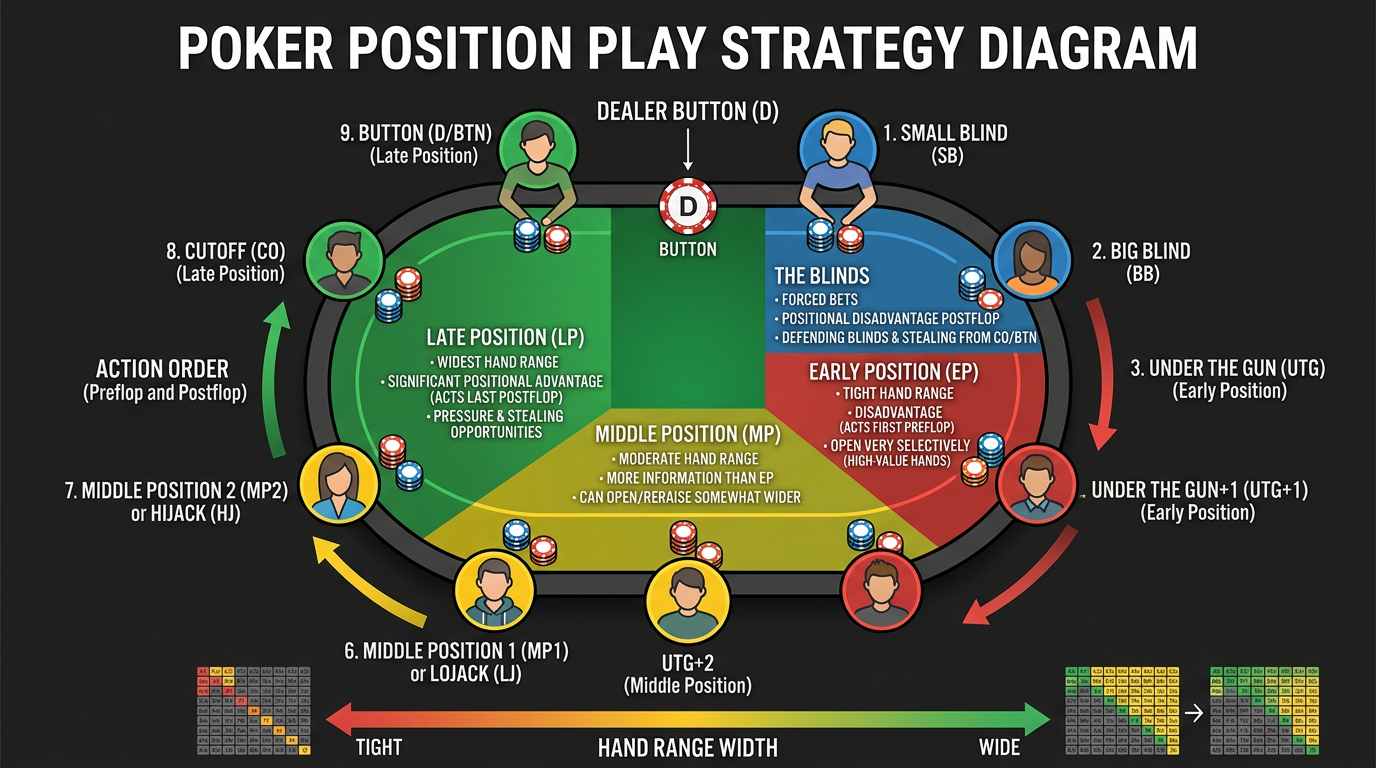
For more on building the strategic foundation that your bankroll supports, explore our guides on position play and advanced bluffing techniques. And when you are ready to put your skills and bankroll to the test, check out our reviews of online poker rooms to find the best games for your level.