Texas Hold’em is the most widely played poker variant in the world, powering everything from casual home games to the main event of the World Series of Poker. Whether you want to join a friendly table or compete in online tournaments, this guide walks you through every rule you need to know, step by step.
The Basics
Texas Hold’em is played with a standard 52-card deck. A table seats between two and ten players. The objective is to win chips by either having the best five-card hand at showdown or by making all other players fold before that point.

Three elements define the structure of every hand:
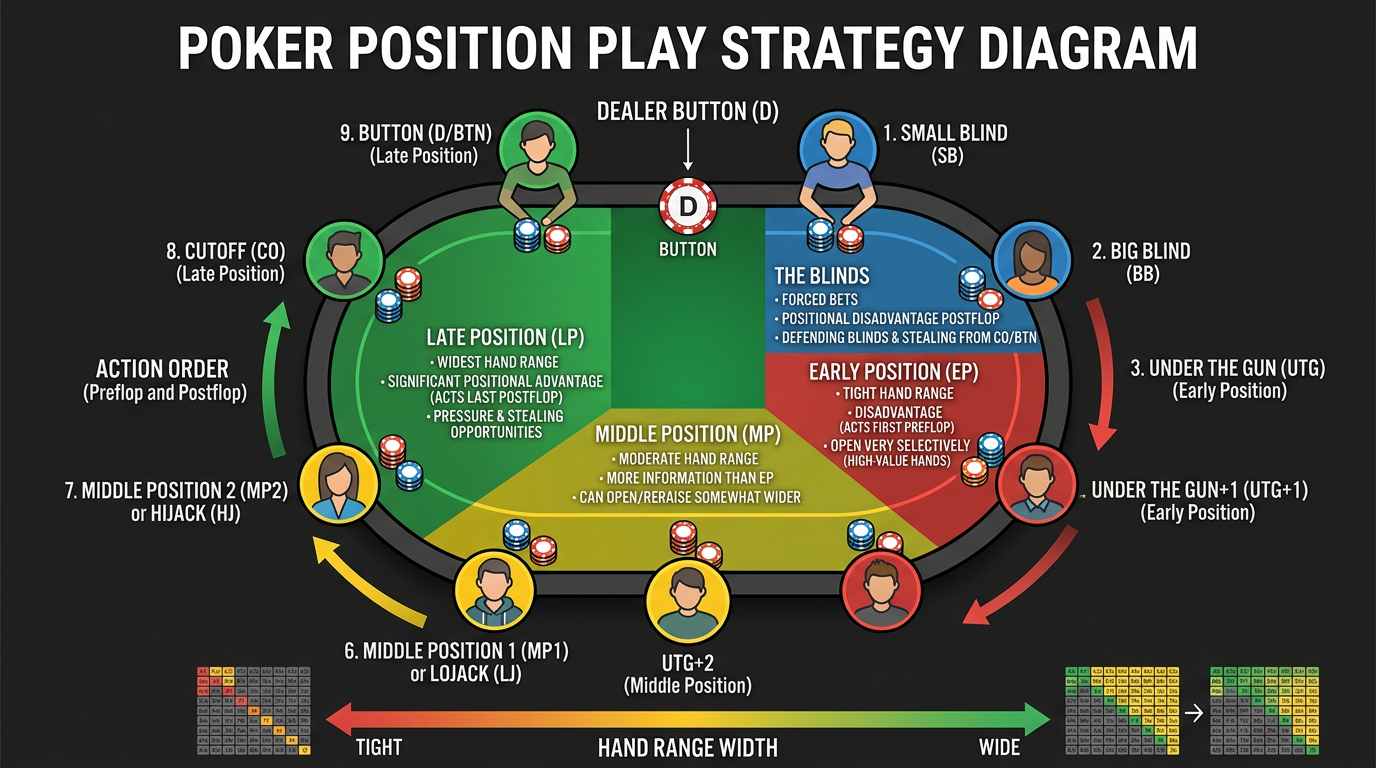
The Dealer Button - A round marker that rotates clockwise one seat after each hand. The player on the button acts last in every post-flop betting round, giving them a strategic advantage. In casino games, a professional dealer handles the cards, but the button still moves to indicate positional order. Understanding the button is the first step toward learning position play.
The Small Blind - The player directly to the left of the button posts a forced bet called the small blind. This is typically half the size of the big blind.
The Big Blind - The player two seats to the left of the button posts the big blind, which sets the minimum bet for the opening round. In a $1/$2 No Limit game, the small blind is $1 and the big blind is $2.
Game Flow: Step by Step

Step 1 - Posting the Blinds
Before any cards are dealt, the small blind and big blind post their forced bets. These mandatory wagers create an initial pot and ensure there is something to compete for in every hand.
Step 2 - Dealing the Hole Cards
Each player receives two cards face down, known as hole cards. These are private and should not be shown to other players. The deal starts with the small blind and moves clockwise, one card at a time, until everyone has two cards.
Step 3 - The Pre-Flop Betting Round
Action begins with the player to the left of the big blind (a seat known as “under the gun”) and moves clockwise. Each player must choose one of the following actions:
- Fold - Surrender your cards and exit the hand. You lose nothing beyond any blinds already posted.
- Call - Match the current bet. Pre-flop, this means matching the big blind (or any raise that has been made).
- Raise - Increase the bet. In No Limit Hold’em, the minimum raise is equal to the previous bet or raise, and the maximum is your entire chip stack.
The big blind acts last pre-flop. If no one has raised, the big blind can check (stay in without adding chips) or raise.
Step 4 - The Flop
After pre-flop betting concludes, the dealer places three community cards face up in the center of the table. These shared cards can be used by every player to build their hand. A “burn card” is discarded face down before the flop is dealt to prevent cheating.
Step 5 - The Flop Betting Round
A new round of betting begins, starting with the first active player to the left of the button. Two additional options become available:
- Check - Pass the action to the next player without betting. This is only possible if no bet has been made in the current round.
- Bet - Place the first wager of the round.
If a player bets, subsequent players must fold, call, or raise.
Step 6 - The Turn
A fourth community card is dealt face up after another burn card. The Turn card is also called “Fourth Street.”
Step 7 - The Turn Betting Round
Betting follows the same structure as the flop round. In fixed-limit games, the bet size typically doubles on the turn.
Step 8 - The River
A fifth and final community card is dealt face up after one more burn card. The River is also called “Fifth Street.” With all five community cards now revealed, players have complete information to assemble their best hand.
Step 9 - The Final Betting Round
One last round of betting takes place, following the same rules as the flop and turn rounds. This is the last opportunity to bet, bluff, or fold before the showdown. Learning when to apply pressure here is part of developing strong bluffing technique.
Step 10 - The Showdown
If two or more players remain after the final betting round, they reveal their hands. The player with the best five-card hand wins the pot. Players can use any combination of their two hole cards and the five community cards to make the best possible five-card hand. You can use both hole cards, one hole card, or in rare cases, none of your hole cards (playing the board).
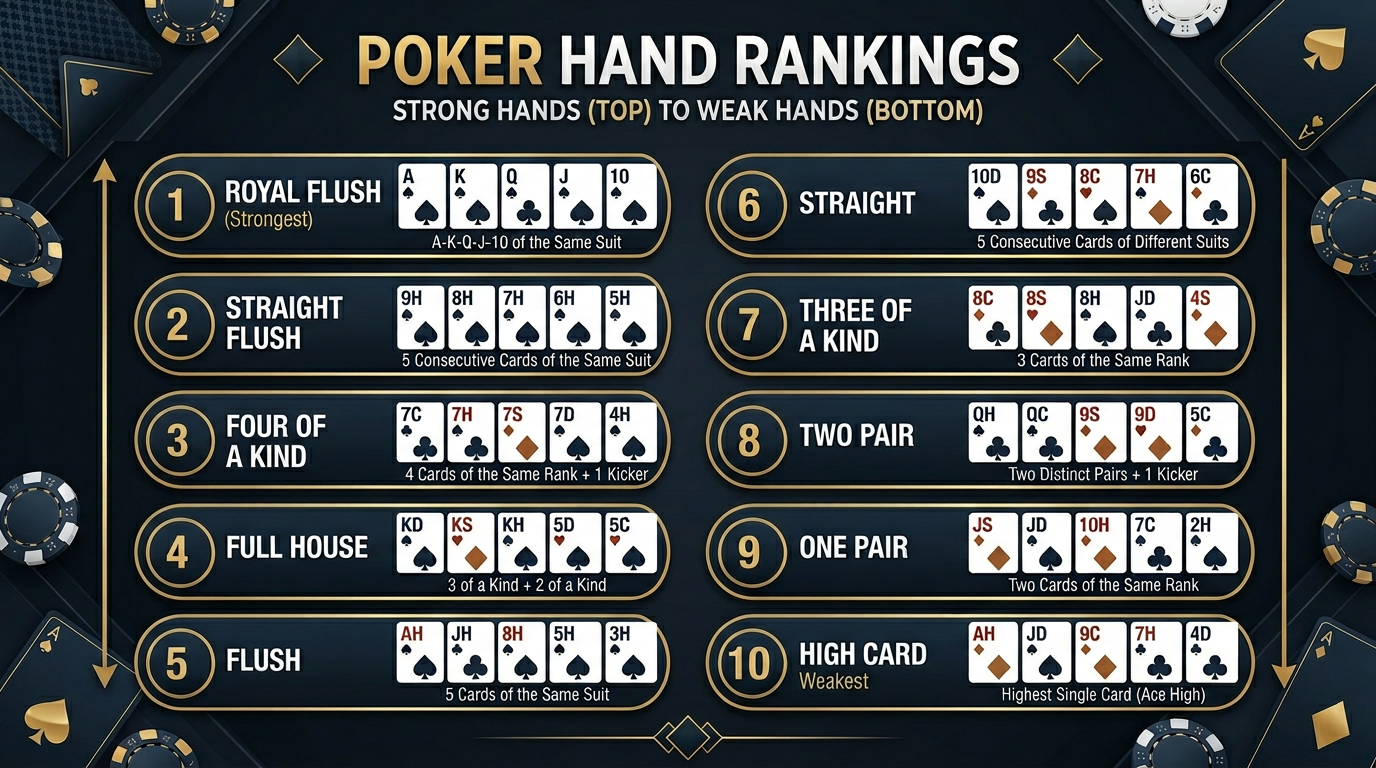
The hand rankings from strongest to weakest are: Royal Flush, Straight Flush, Four of a Kind, Full House, Flush, Straight, Three of a Kind, Two Pair, One Pair, and High Card. See our full hand rankings chart for detailed explanations, probabilities, and examples of each hand.
Betting Actions Explained
Fold - Discard your hand and forfeit any chips already contributed to the pot. Once you fold, you cannot re-enter the hand.
Check - Decline to bet while remaining in the hand. Only available when no bet has been placed in the current round.
Call - Match the current highest bet to stay in the hand.
Bet - Place the first wager in a betting round when no one else has bet yet.
Raise - Increase the size of the current bet. Other players must then call the raise, re-raise, or fold.
All-In - Commit all of your remaining chips to the pot. If you cannot match a full bet or raise, you go all-in for whatever you have. You are eligible to win only the portion of the pot you have matched.
Betting Structures
No Limit (NL) - The most popular format. Players can bet or raise any amount up to their entire stack at any time. This structure creates the largest pots and the most dramatic moments.
Pot Limit (PL) - The maximum raise is limited to the current size of the pot. This format is most associated with Omaha poker (PLO) but can apply to Hold’em as well.
Fixed Limit (FL) - Bets and raises are set at predetermined amounts. Pre-flop and on the flop, bets are at the lower limit; on the turn and river, they double. The number of raises per round is usually capped at three or four.
Making the Best Five-Card Hand
Each player at showdown combines their two hole cards with the five community cards and selects the best possible five-card combination. Out of the seven available cards, you choose exactly five. Key points to remember:
- You do not have to use both hole cards. You can use two, one, or zero.
- Suits are never used to break ties between hands of equal rank.
- If the best five-card hand is composed entirely of community cards, all remaining players split the pot (known as “playing the board”).
Pot Splitting and Side Pots
Split pots occur when two or more players hold hands of identical rank at showdown. The pot is divided equally among the winners.
Side pots are created when a player goes all-in but cannot match the full bets of other players. The all-in player is eligible for the main pot (including their contribution and matching amounts from each caller). Any additional chips bet by remaining players go into a side pot that the all-in player cannot win. Multiple side pots can form if several players go all-in for different amounts.
Table Etiquette and Rules
Following proper etiquette keeps the game fair and enjoyable for everyone:
- Act in turn. Wait for the action to reach you before folding, checking, or betting. Acting out of turn gives information to other players and disrupts the flow.
- Protect your cards. Place a chip or card protector on top of your hole cards to prevent them from being accidentally mucked by the dealer.
- Do not discuss your hand during play. Revealing information about your folded cards or offering advice to active players is prohibited.
- Declare your actions clearly. Say “raise” before placing chips to avoid ambiguity. A single oversized chip placed without verbal declaration is typically treated as a call, not a raise.
- Do not slow-roll. If you know you have the winning hand at showdown, reveal it promptly. Deliberately delaying is considered rude.
- Keep your chips visible. Large denomination chips should remain in clear view so opponents can estimate your stack size.
- Do not splash the pot. Place your bet in a neat stack in front of you rather than tossing chips into the center.
Cash Games vs. Tournaments
Cash Games (Ring Games) - Players buy in for real money and can leave at any time, cashing out their chips for their face value. Blinds remain constant, and you can rebuy if you lose your stack. Cash games reward steady, patient play and strong bankroll management.
Tournaments - Players pay a fixed buy-in and receive a set amount of tournament chips. Blinds increase at timed intervals, forcing action as the event progresses. Play continues until one player holds all the chips. Prize pools are distributed among the top finishers, typically paying the top 10-15% of the field. Tournament play involves additional concepts like ICM (Independent Chip Model) and bubble strategy.
Common Beginner Mistakes
Playing too many hands. New players tend to see flops with weak holdings. Tightening your starting hand selection is one of the fastest ways to improve.
Ignoring position. Position dictates how much information you have when making decisions. Playing hands from early position that you would only play from late position is a costly error. Our guide to position play covers this in depth.
Calling too much, raising too little. Beginners often call when they should raise and raise when they should fold. Raising gives you two ways to win: your opponents fold, or you have the best hand.
Chasing draws without proper odds. Drawing to a Flush or Straight can be profitable, but only when the pot odds justify the call. Calling large bets with slim chances of completing your draw is a long-term losing strategy.
Failing to manage your bankroll. Playing at stakes too high for your bankroll leads to going broke during normal downswings. A solid rule of thumb is to have at least 20-30 buy-ins for the level you are playing.
Letting emotions take over. Going “on tilt” after a bad beat causes players to make irrational decisions. Recognizing emotional responses and stepping away when needed is a skill just as important as reading the board.
What to Learn Next
You now know the complete rules of Texas Hold’em. The next step is memorizing the hand rankings chart until identifying hand strength becomes automatic. From there, study position play to understand how seating affects strategy, and read up on bankroll management to protect your funds as you develop your game.