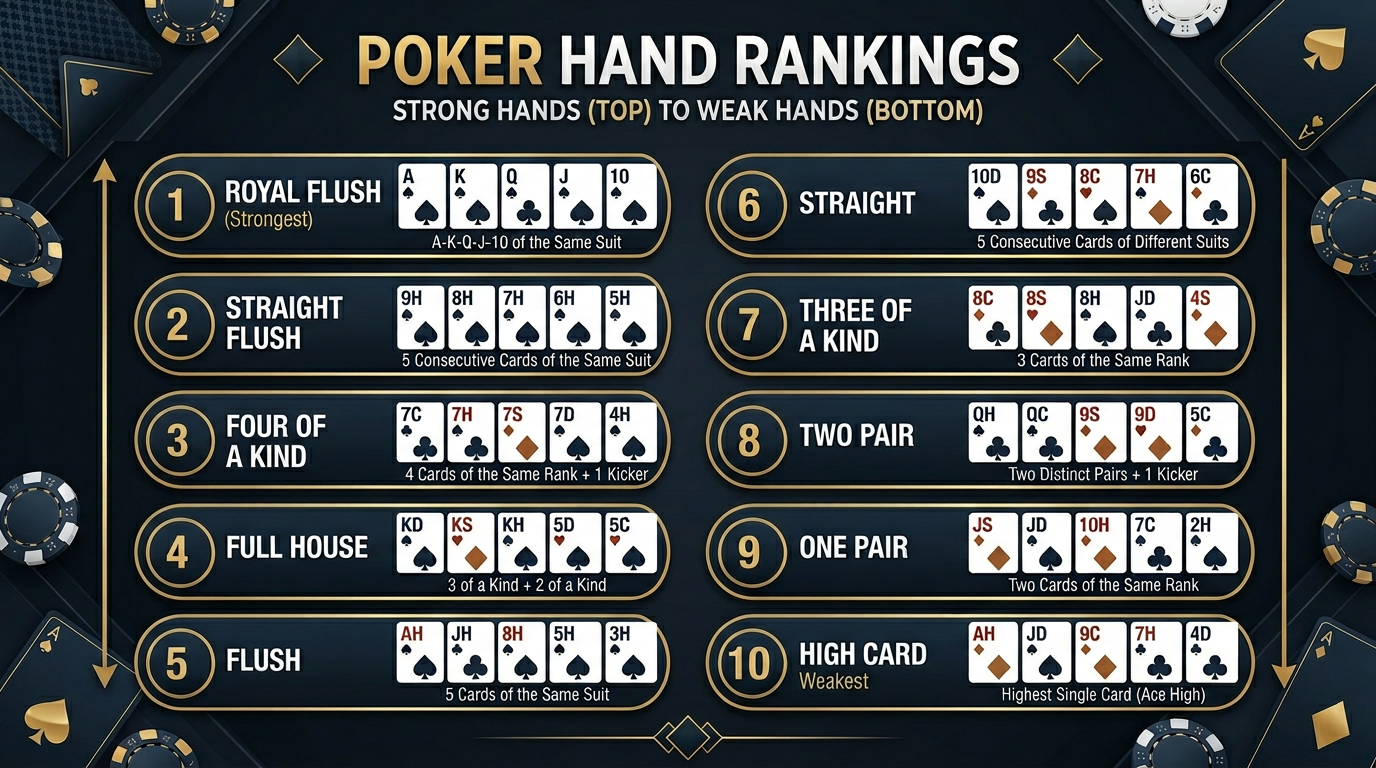
Understanding hand rankings is the single most important foundation in poker. Before you can think about position, bluffing, or any advanced concept, you need to know which hands beat which. This complete guide covers every poker hand from the unbeatable Royal Flush down to the humble High Card, with probabilities, examples, and tiebreaker rules.
All probabilities listed below are based on a standard 52-card deck and refer to the chance of being dealt the hand in a five-card deal.
#1 - Royal Flush
A Royal Flush is the highest possible hand in poker. It consists of the Ace, King, Queen, Jack, and Ten, all of the same suit.
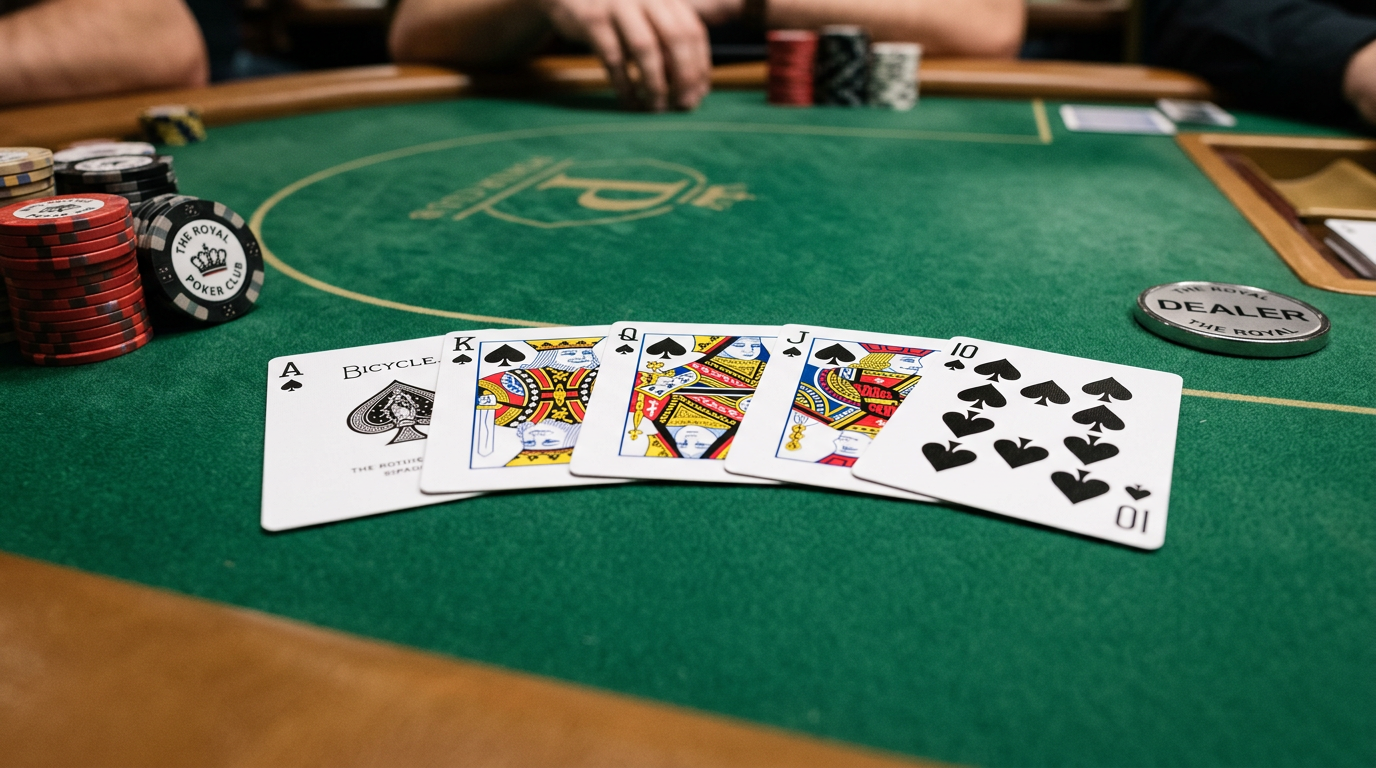
Example: A♠ K♠ Q♠ J♠ 10♠
Probability: 1 in 649,740 (0.000154%)
There are only four possible Royal Flushes in a standard deck, one for each suit. Because it is the top-ranked hand, no other combination can beat it. If two players somehow both hold a Royal Flush (only possible with community cards), the pot is split.
#2 - Straight Flush
A Straight Flush is five cards in sequential order, all of the same suit. A Royal Flush is technically the highest Straight Flush, but it is categorized separately because of its prestige.
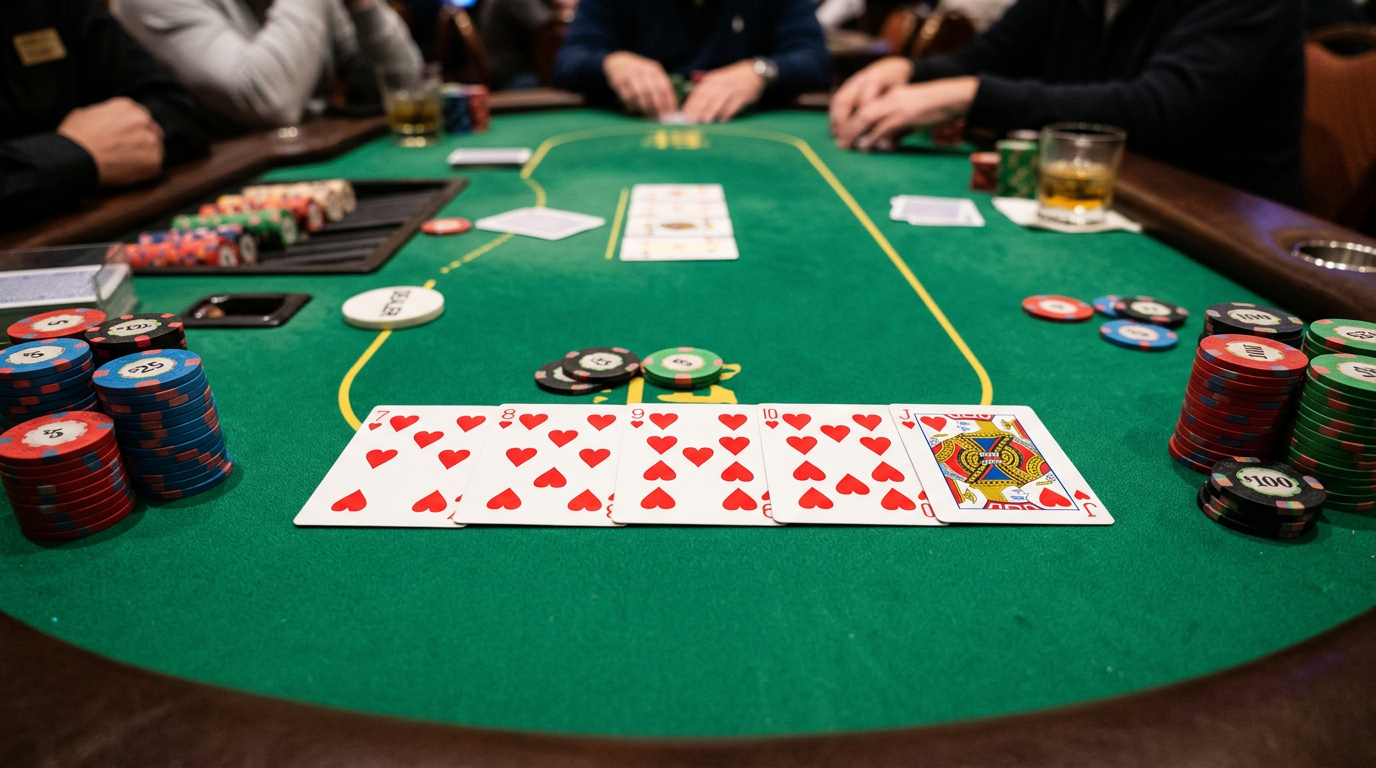
Example: 7♥ 8♥ 9♥ 10♥ J♥
Probability: 1 in 72,193 (0.00139%)
When two players both hold a Straight Flush, the one with the higher top card wins. A 9-high Straight Flush beats a 6-high Straight Flush.
#3 - Four of a Kind (Quads)
Four of a Kind means holding all four cards of the same rank, plus one additional card (the kicker).
Example: K♠ K♥ K♣ K♦ 3♠
Probability: 1 in 4,165 (0.024%)
If two players both have Four of a Kind, the higher set of four wins. If both have the same quads (possible with community cards), the player with the higher kicker takes the pot.
#4 - Full House (Full Boat)
A Full House combines Three of a Kind with a Pair. The hand is ranked first by the three matching cards, then by the pair.
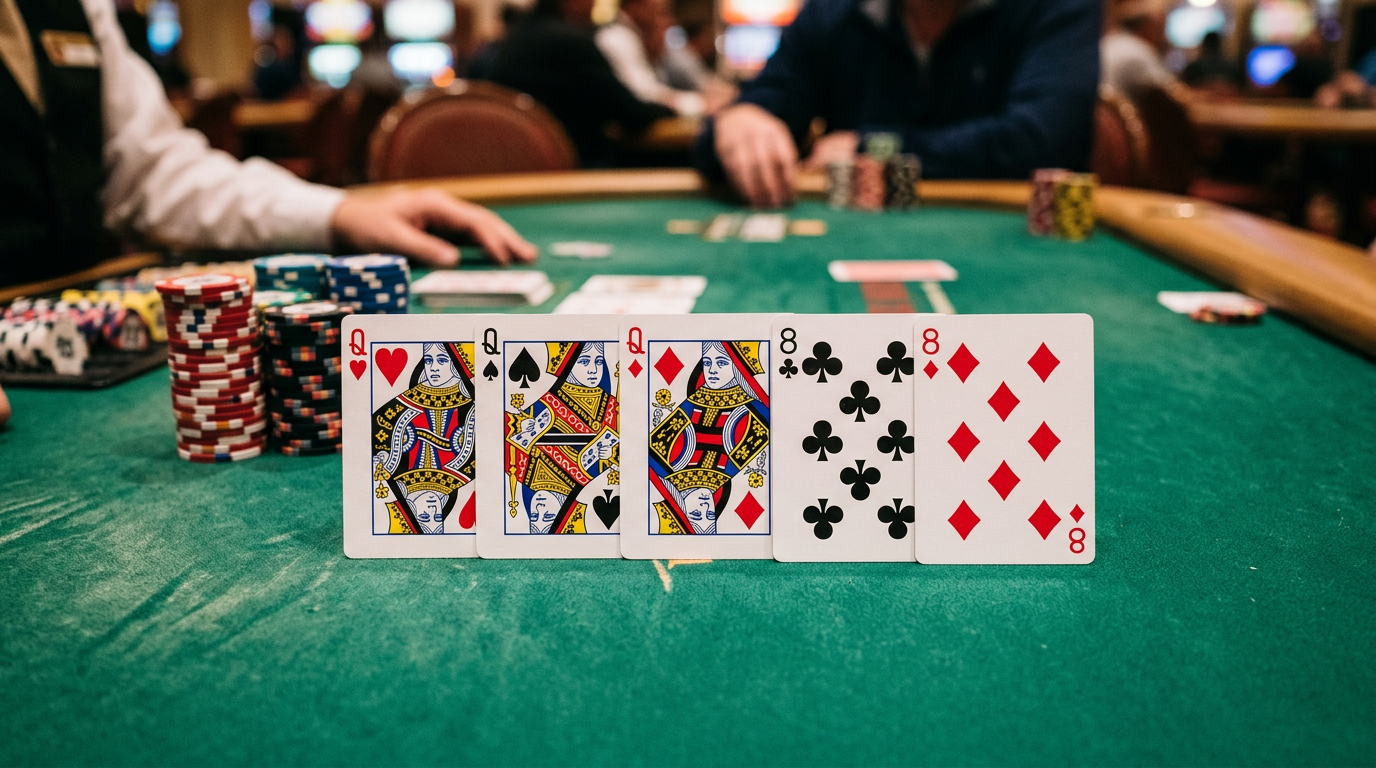
Example: Q♠ Q♥ Q♦ 8♣ 8♠
Probability: 1 in 694 (0.144%)
When comparing Full Houses, the rank of the three-of-a-kind portion decides the winner. Queens full of Eights beats Jacks full of Aces. If the trips are the same, the higher pair wins.
#5 - Flush
A Flush is any five cards of the same suit, not in sequential order. If they were sequential, you would have a Straight Flush instead.
Example: A♦ J♦ 8♦ 5♦ 2♦
Probability: 1 in 509 (0.197%)
Flushes are compared by the highest card first, then the second highest, and so on. An Ace-high Flush always beats a King-high Flush. If the top cards match, the next card down is compared until a winner is determined.
#6 - Straight
A Straight consists of five cards in sequential rank but not all of the same suit.
Example: 5♣ 6♦ 7♠ 8♥ 9♠
Probability: 1 in 255 (0.392%)
The highest card in the sequence determines the Straight’s rank. An Ace can serve as high (A-K-Q-J-10) or low (A-2-3-4-5, known as the “wheel”), but it cannot wrap around (Q-K-A-2-3 is not a valid Straight). Between two Straights, the one with the higher top card wins.
#7 - Three of a Kind (Trips or Set)
Three of a Kind means three cards of the same rank, with two unrelated side cards. In Hold’em, a “set” refers to holding a pocket pair that matches one board card, while “trips” means one hole card matches two board cards.
Example: 9♠ 9♥ 9♣ K♦ 4♠
Probability: 1 in 47 (2.11%)
The rank of the three matching cards is compared first. If both players have the same trips, the higher kickers decide the winner.
#8 - Two Pair
Two Pair contains two different pairs plus one kicker card.
Example: A♠ A♥ 7♣ 7♦ J♠
Probability: 1 in 21 (4.75%)
The highest pair is compared first. If both players share the same top pair, the second pair is compared. If both pairs match, the kicker determines the winner.
#9 - One Pair
One Pair means exactly two cards of the same rank, with three unrelated cards.
Example: 10♠ 10♦ A♥ 6♣ 3♠
Probability: 1 in 2.37 (42.26%)
The rank of the pair is compared first. If both players have the same pair, the highest kicker wins. If the first kicker ties, move to the second, then the third.
#10 - High Card
When a hand contains none of the above combinations, it is ranked by its highest card alone. This is the weakest possible holding.
Example: A♠ J♦ 8♣ 5♥ 2♠
Probability: 1 in 2 (50.12%)
High Card hands are compared from the top down. An Ace-high hand beats a King-high hand. If the highest cards match, the second card decides, continuing until a winner is found or all five cards are identical (resulting in a split pot).
Tiebreaker Rules: Understanding Kickers
A kicker is an unpaired side card used to break ties when two players hold the same ranked hand. Kickers matter most with One Pair, Two Pair, Three of a Kind, and Four of a Kind.
Key kicker principles:
- Only the best five cards count. In Hold’em, you choose five from seven available cards.
- With One Pair, up to three kickers can come into play.
- With Two Pair, only one kicker matters.
- With Three of a Kind, up to two kickers matter.
- Flushes and Straights do not use kickers; all five cards are part of the hand itself.
- Full Houses compare the trips first, then the pair. There is no separate kicker.
Example tiebreaker: Player A holds K-10, Player B holds K-9. The board shows K-7-5-3-2. Both have a pair of Kings, but Player A’s 10 kicker beats Player B’s 9.
Common Mistakes in Hand Ranking
Thinking a Flush beats a Full House. A Full House ranks above a Flush. This is one of the most frequent errors new players make.
Believing the Ace cannot be low in a Straight. The Ace can form both the top of A-K-Q-J-10 and the bottom of A-2-3-4-5. However, it cannot connect a wrap-around like K-A-2-3-4.
Ignoring kickers. Many beginners celebrate top pair without noticing their kicker is weak. A player holding A-K with a pair of Aces on board will beat a player holding A-6 every time.
Confusing Two Pair with a stronger hand. Two Pair feels powerful but loses to Three of a Kind, which is only one rank higher. Do not overvalue Two Pair on dangerous boards.
Forgetting suit does not determine rank between hands. There is no suit hierarchy in standard poker. A Flush of spades is equal to a Flush of hearts if the card ranks are identical.
Quick Reference Summary
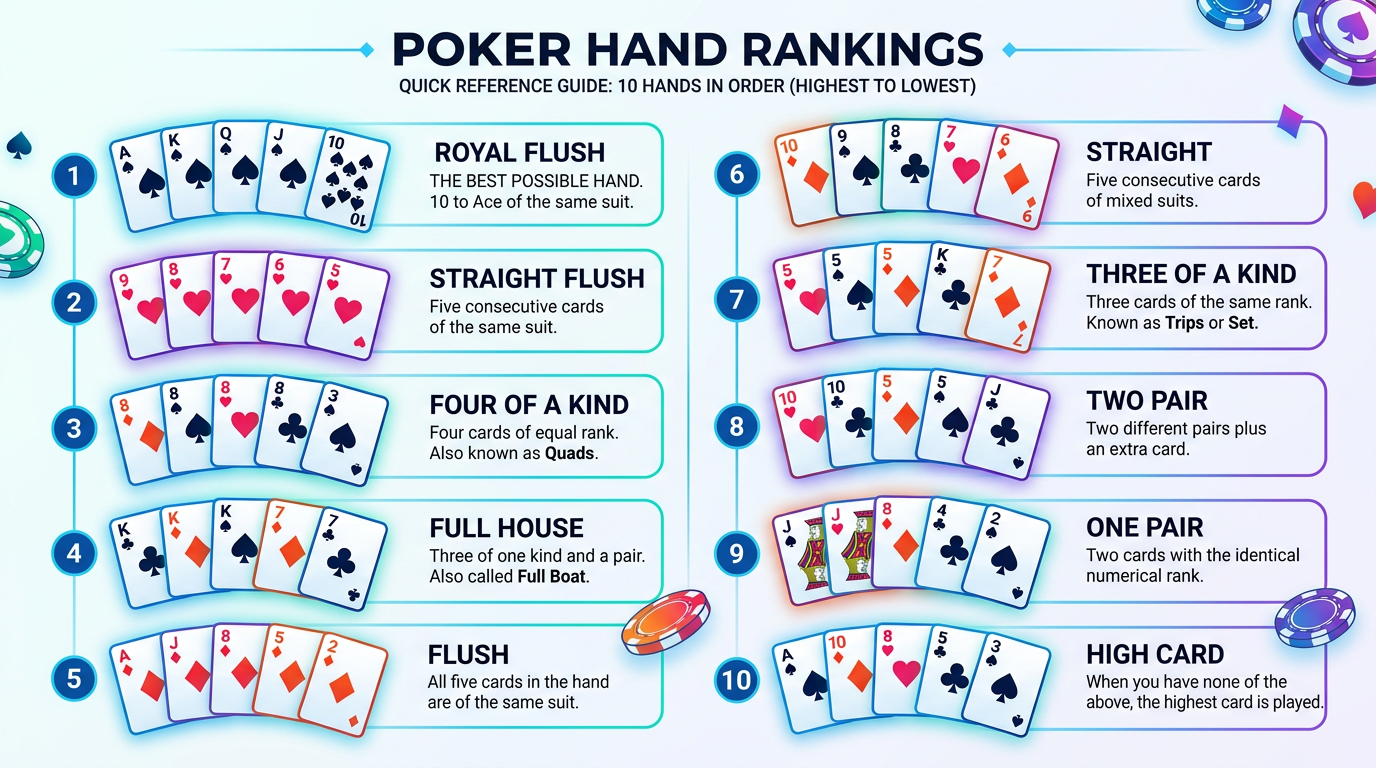
| Rank | Hand | Example | Probability |
|---|---|---|---|
| 1 | Royal Flush | A K Q J 10 (same suit) | 1 in 649,740 |
| 2 | Straight Flush | 7 8 9 10 J (same suit) | 1 in 72,193 |
| 3 | Four of a Kind | K K K K 3 | 1 in 4,165 |
| 4 | Full House | Q Q Q 8 8 | 1 in 694 |
| 5 | Flush | A J 8 5 2 (same suit) | 1 in 509 |
| 6 | Straight | 5 6 7 8 9 | 1 in 255 |
| 7 | Three of a Kind | 9 9 9 K 4 | 1 in 47 |
| 8 | Two Pair | A A 7 7 J | 1 in 21 |
| 9 | One Pair | 10 10 A 6 3 | 1 in 2.37 |
| 10 | High Card | A J 8 5 2 | 1 in 2 |
What to Learn Next
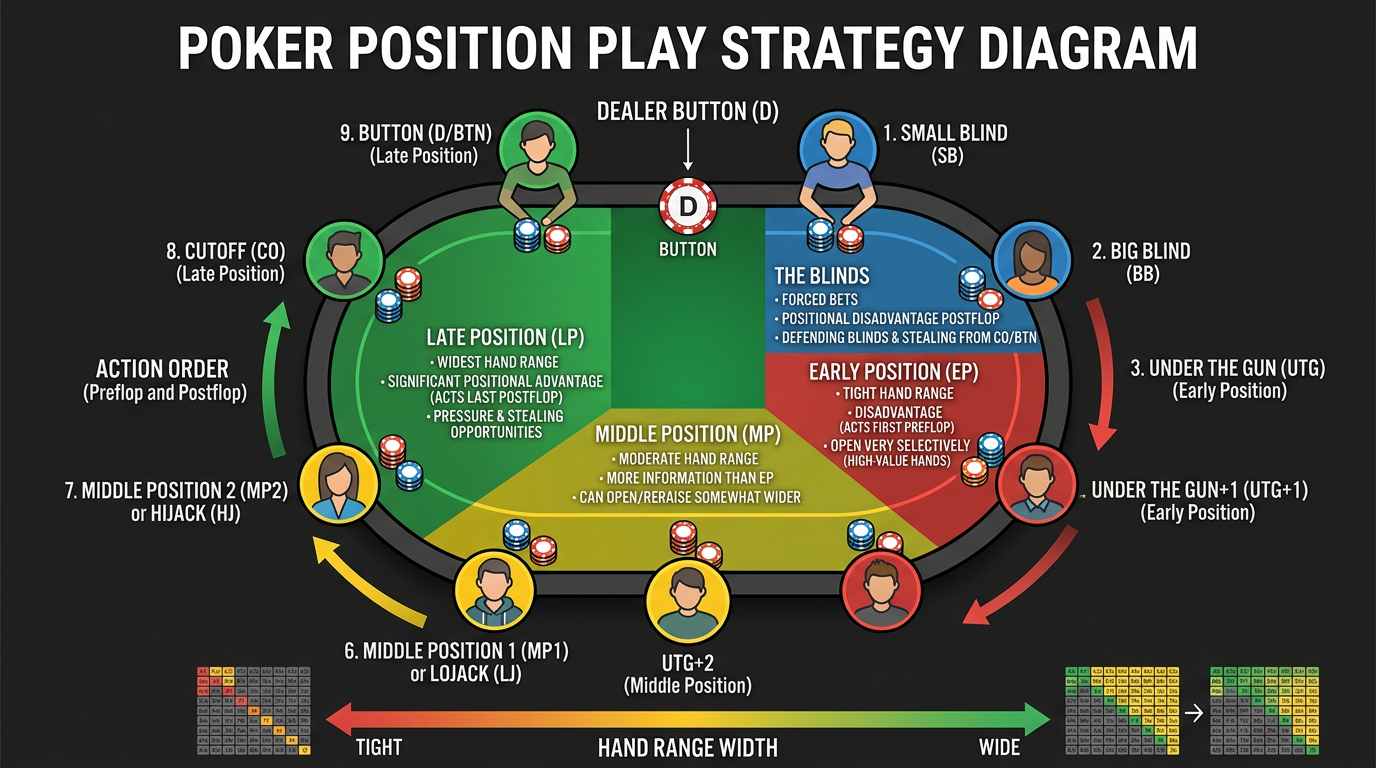
Now that you know the rankings by heart, it is time to put them into action. Understanding position play will teach you how table position affects which hands you should play. From there, bluffing techniques will show you how to win pots even when your hand ranking is weak. If you are brand new to the game, start with our complete poker rules guide for a full walkthrough of how a hand is dealt and played.