
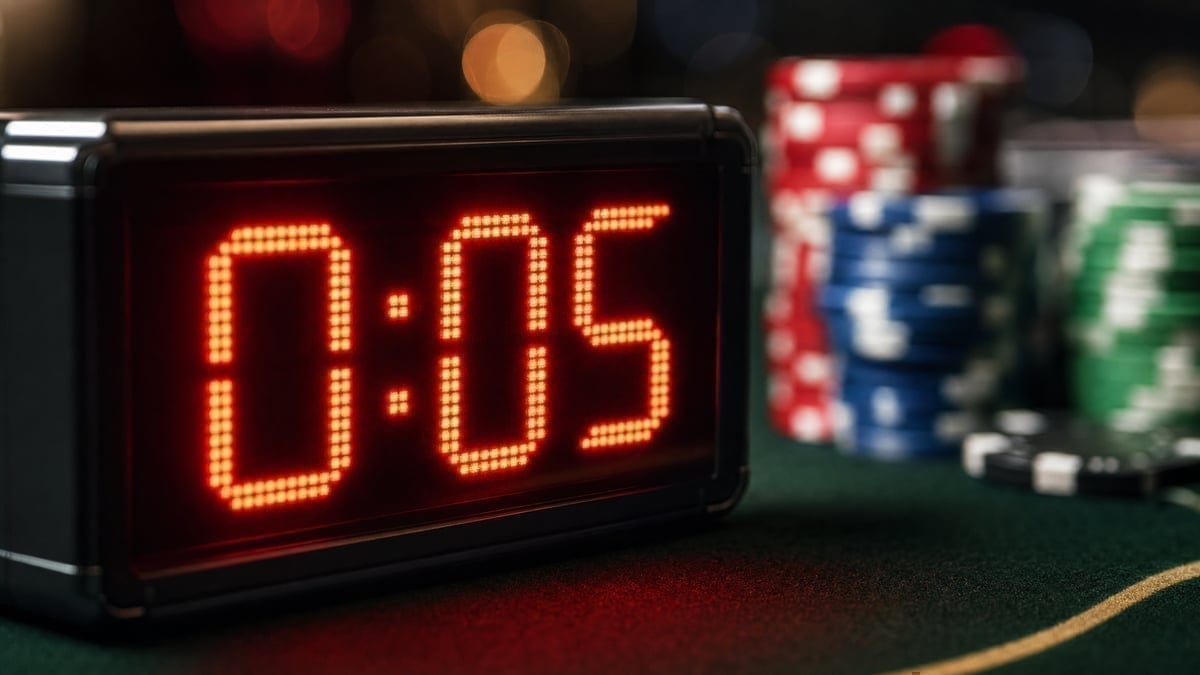
The clock hits fifteen seconds. A player with $2 million in chips stares at pocket kings, sweat beading on his forehead. Ten seconds. The dealer’s hand hovers near the deck. Five seconds. In the old days, this decision might have taken five minutes. Today? Time’s up.
Triton Poker just dropped their Tempo format on the high-stakes world, and the poker universe is having a moment. The new shot clock system gives players just 15 seconds per decision in regular pots, 30 seconds when facing all-ins. No time banks. No extensions. Just pure, rapid-fire poker at nosebleed stakes.
The Pros Are Split Down the Middle
“This is exactly what poker needed,” tweeted Jason Koon after testing the format in Jeju. “We’re playing twice as many hands. The recreational players love it. The game flows like water.”
But not everyone’s singing the same tune.
Fedor Holz fired back on social media: “Poker at these stakes requires deep thinking. We’re not playing online turbos here. Some decisions need time, especially when millions are on the line.”
The German high roller isn’t alone. Several pros who’ve dominated the traditional format worry about losing their edge when complex ICM spots get compressed into seconds.
“I watched a guy snap-fold queens preflop because he couldn’t calculate the bubble dynamics fast enough,” one regular told me at EPT Barcelona. “That’s not poker anymore. That’s just gambling.”
The Recreational Revolution
Here’s where it gets spicy. The businessmen and crypto whales funding these games? They’re absolutely loving Tempo.
“Before, I’d sit there for twenty minutes watching someone tank with ace-high,” says a Malaysian businessman who plays the circuit. “Now we actually play poker. More hands, more action, more fun.”
Paul Phua, Triton’s founder, knew exactly what he was doing. The format addresses the biggest complaint from recreational players - the endless tanking that turns a tournament day into a marathon of waiting.
And the numbers back it up. Triton’s Tempo events are seeing 40% more hands per level. That translates to more opportunities for skilled players to find spots, but less time to execute perfect GTO calculations.
The Poker Economy Speaks
Tournament directors across the globe are watching closely. The World Series of Poker already uses shot clocks for their high rollers, but Triton’s aggressive timing takes it further.
“If this catches on, we’ll need to retrain dealers, update our procedures, invest in technology,” admits a floor manager from a major European casino. “But if it brings in more recreational money, everyone wins.”
WPT Global announced they’re testing similar formats online. GGPoker already runs speed tournaments, but applying this to high stakes changes the entire ecosystem.
The economic argument is simple. Faster play means more rake per hour for operators. More hands means more action for players. But it also means the skill gap might narrow when players can’t tank their way to perfect decisions.
What This Actually Means
Forget the noise - let’s talk reality. Tempo format fundamentally changes poker mathematics.
In traditional high stakes, a player might take three minutes to work through pot odds, implied odds, and opponent ranges. Now? You’re playing more on instinct, pattern recognition, and preparation.
“I’m spending four hours a day now drilling common spots,” admits a European pro. “If you can’t think fast enough at the table, you better know the answer before you sit down.”
Some pros are hiring chess players to improve their rapid decision-making. Others are grinding online turbos to adjust to the speed. The entire training ecosystem is shifting.
The Technology Arms Race
Triton’s new system isn’t just a chess clock on the table. It’s integrated LED displays, automatic warnings, and synchronized timing across multiple tables.
The dealer training alone costs thousands per event. The technology investment runs into six figures. But Triton’s betting this pays off through increased player satisfaction and more efficient tournaments.
“We can run a $100K event in one day now instead of two,” a Triton spokesperson explained. “Players fly in, play a massive tournament, and fly out. No more three-day commitments for a single event.”
Where We Go From Here
Love it or hate it, Tempo is here to stay. The next Triton series will feature 50% Tempo events. Other tours are designing their own variations.
The pushback from traditional grinders feels inevitable. Of course players who built their edge on deep thinking time feel threatened. But poker evolves. Online poker killed the live tells game. Solvers changed how we think about ranges. Now shot clocks might change how we apply that knowledge.
That smartest pros aren’t fighting this wave - they’re learning to surf it. Because at the end of the day, poker rewards adaptation. The players crying about lost thinking time are the same ones who complained about HUDs fifteen years ago.
Meanwhile, the recreational players keeping these games alive finally get what they’ve been asking for. Fast action, less waiting, more gambling. And really, isn’t that what high-stakes poker should deliver?
The clock’s ticking on the old guard. Time to adjust or get left behind.


