
GTO Strategy has gone live with a new poker study platform built around solver-backed decisions, training drills and competitive game modes. Its core promise is to make GTO work less like a spreadsheet session and more like repeatable practice.
Poker training has become a serious arms race, but a lot of solver work still feels like homework with a subscription attached. GTO Strategy is trying to move the experience closer to a playable training environment, where users can look up spots, drill decisions and compete on leaderboards without building their own game trees from scratch.
The platform was developed in collaboration with cash game pro Owen “PR0DIGY” Messere and Patrick “Pads” Leonard. It also traces part of its roots to Odin Poker, the tool launched in 2021 by high-stakes professional Rory Young.
The public site positions GTO Strategy as a solver, simulator, trainer and study platform, with pre-solved decisions and a free starting tier. The more useful promise is habit-building: taking solver output and forcing enough decisions that the lesson survives away from the study screen.
Three Modes: Solve, Train and Compete
GTO Strategy is built around three main modes.
Solve is the lookup layer. Players can load a spot and see a GTO breakdown for actions such as betting, calling, checking or folding. The platform covers preflop, heads-up postflop and multi-way postflop spots across cash games and tournaments, with and without antes, from 4-max to 9-max formats. ICM and 8-max MTT scenarios are also part of the coverage.
Experienced players will judge that coverage quickly. A lookup tool is only as useful as the spots it covers, and multi-way postflop plus tournament-specific scenarios are where a lot of poker software still gets clunky.
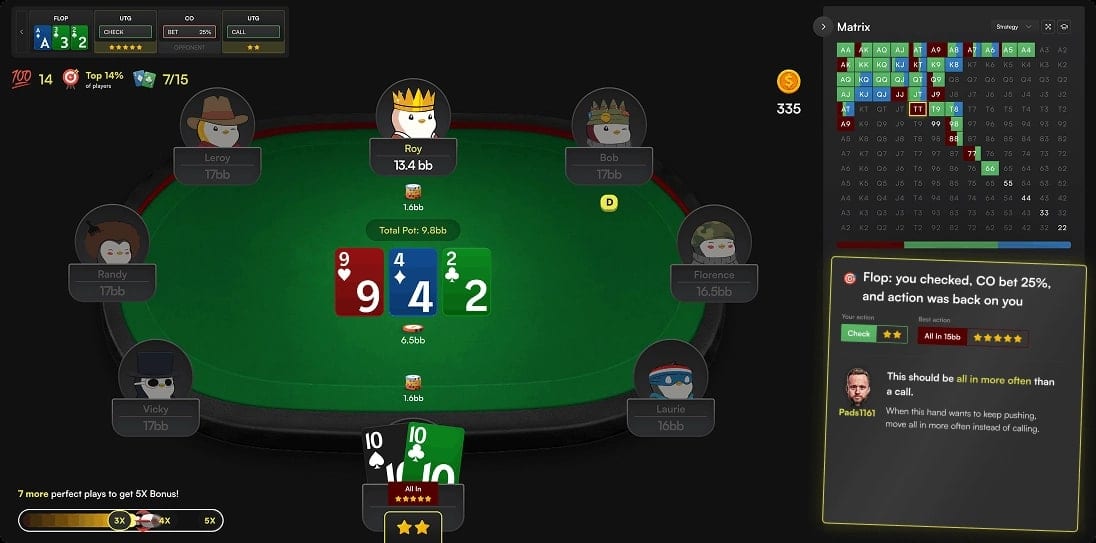
Train turns those spots into reps. Users are dealt hands, make decisions and receive immediate feedback against the solver output. The training view combines a table layout, decision grading and coach-style feedback explaining why one line performs better than another.
This is where the product has its clearest audience. Newer players often know they should study, but not what to study first. Stronger players know exactly what they need, but still need a way to drill the same spots until the answer becomes automatic. A training mode that grades decisions quickly can serve both groups, provided the feedback stays clear enough for players who have never opened a solver before.
Compete is the more unusual piece. GTO Strategy is adding leaderboards, weekly challenges and real-money prize incentives through an integration with CoinPoker. Players are matched on identical hands, which means the leaderboard is not simply rewarding who got dealt the best spot. It is measuring how closely users make decisions against the same strategic tests.
Why the CoinPoker Tie-In Matters
Most poker study tools are solitary. You review ranges, drill a few hands, close the tab and hope some of it survives the next session. GTO Strategy is betting that competition can keep players coming back.
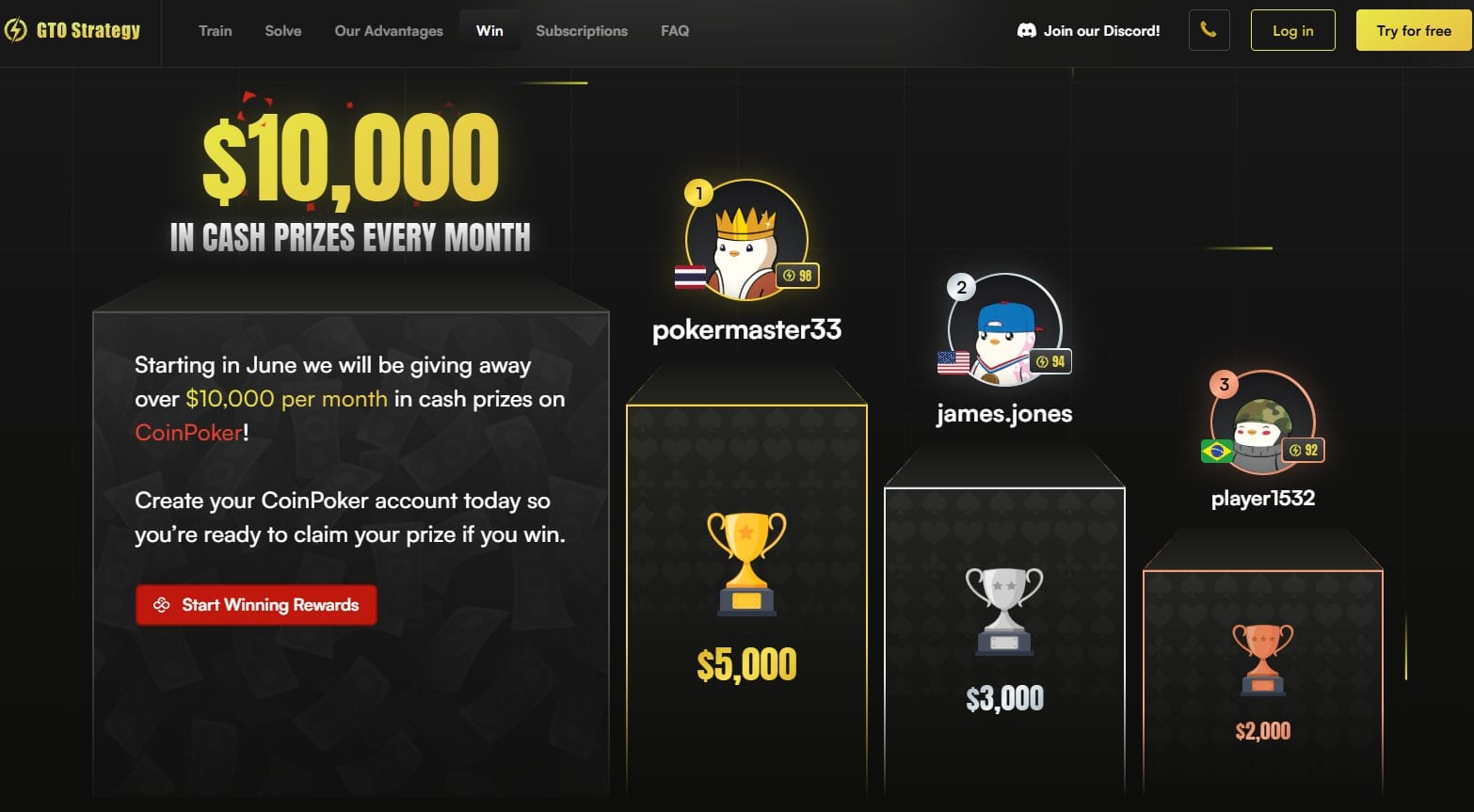
The competition page lists monthly cash prizes connected to CoinPoker, including a displayed $10,000 monthly prize pool and podium prizes of $5,000, $3,000 and $2,000. Players need to link a GTO Strategy account with a CoinPoker account to be eligible for those prizes.
Poker players already respond to rankings, challenges and visible progress. Turning study into something with stakes gives the platform a hook that a pure solver viewer does not have.
The risk is obvious enough: leaderboards can push people toward chasing scores rather than understanding the why behind decisions. The useful version of this model is not “click buttons until the grade is green.” It is a structure where players learn why their instinct was wrong, then get enough similar reps to correct it. The training feedback will matter as much as the prize pool.
Built for Players Who Do Not Want Solver Setup
GTO Strategy is aimed at players who want solver-backed work without solver setup.
Users can access millions of pre-solved spots without running calculations themselves. The site also markets the platform around fast access to preflop and postflop solutions, custom solves and training. For players who have only used static charts, that could be a meaningful step up.
That gap is real. Traditional solver study asks players to understand ranges, node structure, bet sizes, board textures, filters and EV output before they even get to the lesson. That is fine for high-stakes regulars. It is intimidating for a mid-stakes player trying to fix leaks before Sunday tournaments.
PokerRift readers who are newer to study should still treat solver output as a baseline, not a script. GTO work can help explain balanced strategy, but real games still involve table selection, opponent tendencies, position, pot odds and bankroll discipline. Our advanced bluffing guide covers that GTO-versus-exploitative tension in more detail.
Pricing and Access
GTO Strategy launches with a free tier that gives limited access to solves, training and game modes. The Standard plan is listed at $39 per month and covers most features. The Elite plan is listed at $79 per month, with postflop multi-way solutions and custom AI solves reserved for that tier.
Both paid plans include a seven-day free trial. The platform’s Discord is also open for players who want to follow updates or ask questions before committing to a subscription.
That pricing puts GTO Strategy in the serious-study category, but not wildly outside the market for solver-backed poker tools. Its case depends on whether the training and competition layer gets players to use it consistently. A tool you actually open four times a week is worth more than a technically deeper one you avoid because it feels like work.
What Has To Stick
GTO Strategy is entering a crowded training market, so novelty alone will not carry it. Serious players already have options for charts, solver databases and hand review. The interesting part here is the combination: solver lookup, training feedback, progress tracking and competitive incentives in one product.
If the interface stays approachable and the feedback is strong, GTO Strategy has a clean lane: players who know they need solver study but bounce off traditional tools. If the competition mode becomes the main attraction, it may also find a second audience among grinders who want a reason to turn study into a daily habit.
The platform is live at GTOStrategy.com, with free access available and paid tiers starting at $39 per month.


