
The Science of Survival
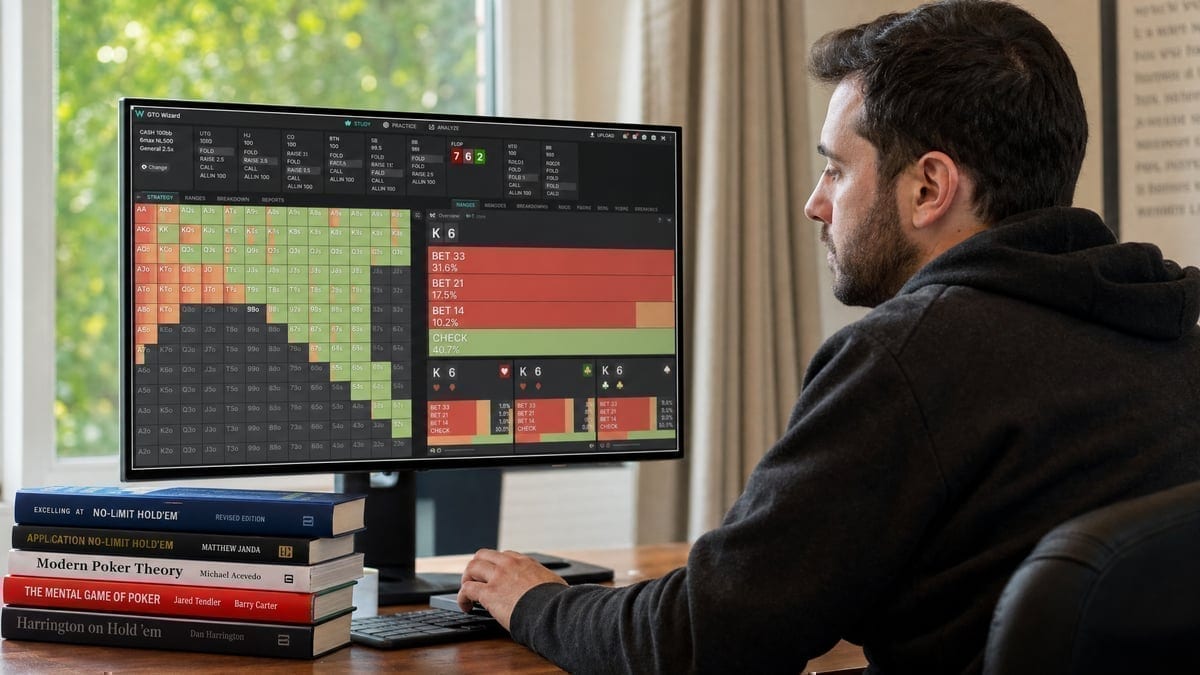
Dara O’Kearney sits in his Dublin home office, surrounded by solver outputs and tournament graphs. The rain taps against the window as he explains his preparation for this summer’s WSOP. It involves considerably less champagne and considerably more mathematics than most players’ approaches.
“If you play by these, you’re going to win,” he says, gesturing at a screen filled with ICM calculations for multi-way pots.
The 58-year-old Irish pro has been quietly revolutionizing his game ahead of the series, diving deep into territory most players still avoid: multi-way pot dynamics and the mathematical realities of tournament survival.
Pro Reactions Split on Solver Evolution
The poker community’s response to O’Kearney’s solver-heavy approach reveals a generational divide that’s only getting wider.
Younger pros embrace the technology. “Finally someone’s talking sense about multi-way spots,” tweeted German high roller Dominik Nitsche. “Most people still play these terribly.” Several online grinders chimed in, sharing their own experiences with the latest solver developments.
But veterans remain skeptical. One long-time Vegas regular who requested anonymity called it “paralysis by analysis.” He added, “You can study all the charts you want. When you’re sitting across from someone at the Rio, it’s still about reading the person.”
The debate touches on something fundamental about modern poker. As solvers become more sophisticated, the gap between those who study them and those who don’t continues to widen. O’Kearney himself acknowledges this evolution: “The solvers have finally caught up to multi-way complexity.”
Industry Watches ICM Revolution
Training site operators are already adapting to this shift. Run It Once recently added a dedicated multi-way section, while several coaches report increased demand for ICM-focused content.
“We’re seeing 300% more searches for multi-way ICM content compared to last year,” says a representative from a major training platform.
The timing isn’t coincidental. With the WSOP Main Event featuring deeper structures and more complex pay jumps than ever, understanding these dynamics has become essential for serious players. O’Kearney’s focus on this area positions him ahead of the curve.
The Bowie Connection
Perhaps the most unexpected element of O’Kearney’s story involves an email exchange with David Bowie. Yes, that David Bowie.
It started when O’Kearney wrote about poker in one of his columns years ago, using Bowie lyrics as metaphors for variance. To his shock, the musician himself responded.
“He was surprisingly knowledgeable about probability,” O’Kearney recalls. “We exchanged maybe three or four emails about randomness and decision-making.”
The correspondence ended when Bowie passed away in 2016, but it left an impression. O’Kearney still has the emails saved, though he’s protective of their contents. “It was personal,” he says. “But it reinforced something I’d always believed - that poker attracts people who think differently.”
Mental Game Adjustments
Beyond the mathematical preparation, O’Kearney has been working on his table presence. He admits past mistakes.
“I used to treat poker a bit too much like a social event,” he says. The Dublin rain has turned to drizzle now, casting grey light across his study. “When you’re in a hand, you should give your entire focus to making the best decision that you can.”
This represents a shift for someone known on the European circuit for his affable nature. But as buy-ins increase and edges shrink, even small improvements in focus can translate to significant expected value.
He’s cut out table chat during hands. Started wearing noise-canceling headphones more often. Small changes, but they add up. “It’s not about being unfriendly,” he clarifies. “It’s about respecting the game - and your bankroll.”
Fan Reactions and Skepticism
Amateur players following O’Kearney’s preparation have mixed feelings. His transparency about the work required to compete at the highest levels both inspires and intimidates.
“Makes me realize how far behind I am,” posted one recreational player on a poker forum. Another countered: “This is exactly why I stick to home games. Too much like homework.”
O’Kearney understands both perspectives. He started as a recreational player himself, transitioning to poker after a career as an ultra-marathon runner. That background in endurance sports shaped his approach to studying the game.
“People see the grind and think it’s joyless,” he says. “But there’s real satisfaction in understanding something deeply. When you make a play that you know is mathematically correct, even if it doesn’t work out that specific time - that’s its own reward.”
The rain has stopped now. Dublin’s afternoon light filters through the window, illuminating spreadsheets and solver outputs. O’Kearney turns back to his computer, ready for another session of preparation. The WSOP is still months away, but in the race for edges, the work never really stops.
His parting thought captures something essential about modern tournament poker: “The game keeps evolving. You either evolve with it or get left behind. There’s no standing still anymore.”


