
The poker industry just witnessed a fascinating case study in promotional economics gone wrong. 888poker’s ambitious zero-rake experiment for their XL Spring RakeLESS Main Event has backfired in spectacular fashion, with the $500,000 guaranteed tournament tracking toward a six-figure overlay as registration enters its final hours.
The Numbers Tell a Brutal Story
888poker eliminated rake entirely for this flagship event – normally a $215 buy-in would include roughly $15 in fees. By making it $200 flat, they essentially gave players a 7.5% discount. The theory was simple: lower the barrier to entry, attract more players, generate buzz for the XL Spring Series.
But here’s where market dynamics kicked in hard.
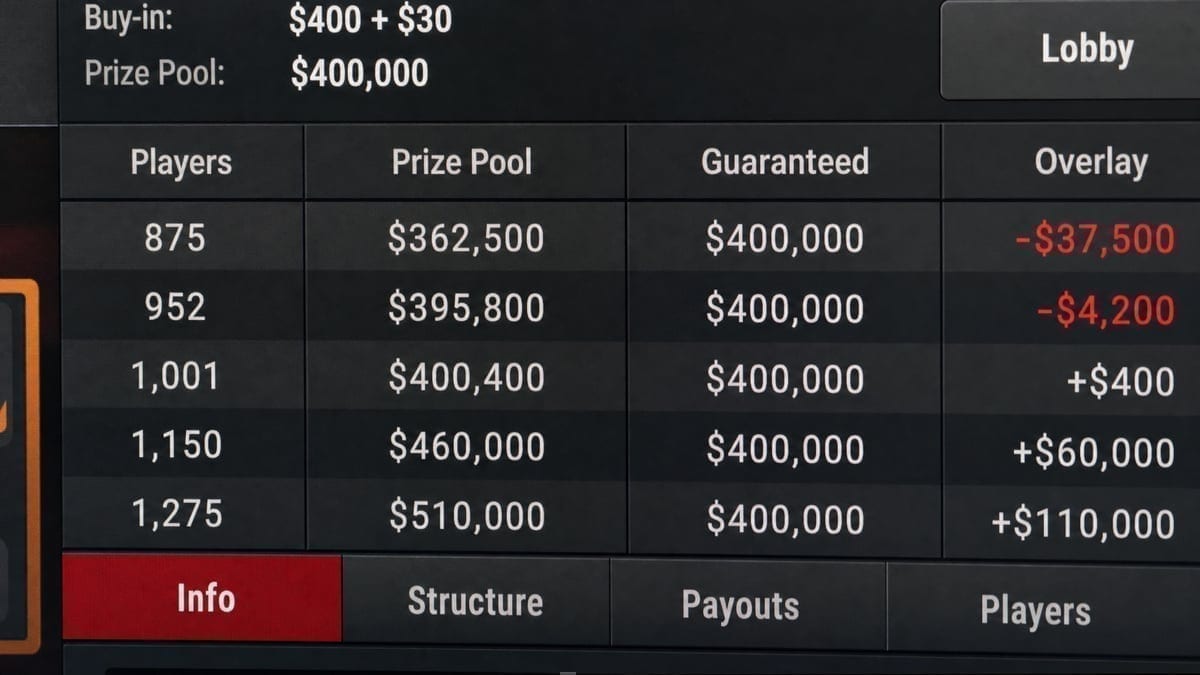
With just 1,847 entries registered and late registration closing soon, the tournament needs 2,500 players just to meet its guarantee. That’s a shortfall of over 650 buy-ins, translating to a potential $130,000+ overlay. For context, that’s more than many tournaments’ entire prize pools.
The timing couldn’t be worse. 888poker recently reported strong Q1 2026 results in several markets, particularly in shared European liquidity pools. This overlay threatens to erase weeks of profit from a single promotional decision.
Why Zero Rake Doesn’t Equal Zero Risk
The RakeLESS promotion illuminates a fundamental misunderstanding of player psychology and market positioning. In the mid-stakes online tournament ecosystem, rake isn’t the primary consideration for most players – it’s field size, structure, and competition level.
Think about it from a grinder’s perspective. A professional playing 500 tournaments monthly saves maybe $7,500 if every event went rake-free. Sounds great, except that same pro makes their real money from ROI against recreational players. And recreational players? They’re choosing sites based on software, promotions, and brand trust – not whether they save fifteen bucks on entry fees.
888poker sits in third place globally behind PokerStars and GGPoker. Their player pool, while respectable, lacks the critical mass to support massive guarantees without carefully calibrated marketing spend. This isn’t 2018 when sites could throw money at guarantees and expect organic growth to follow.
The Overlay Economy Creates Winners and Losers
For players who did register, this overlay represents extraordinary expected value. Each entry now claims roughly $270 in prize pool equity for their $200 investment – a 35% immediate return before cards are even dealt. Tournament regs are likely firing multiple bullets, maximizing their exposure to this +EV situation.
But overlays create a vicious cycle. When a site bleeds money on guarantees, they compensate through:
- Reduced future guarantees
- Higher rake on cash games
- Fewer promotional offerings
- Scaled-back loyalty programs
We saw this pattern with PartyPoker’s failed Millions Online events, where repeated seven-figure overlays led to guarantee slashing across their entire schedule. BetMGM learned similar lessons after their $1 million overlay debacle in 2024.
Market Timing Makes Everything Worse
888poker’s promotional misfire comes at a particularly challenging moment for the online poker ecosystem. The industry faces multiple headwinds:
First, player liquidity remains fragmented. While some US states are opening up, international markets face increasing regulatory pressure. The UK’s recent tax changes have operators scrambling to maintain margins. Spain’s market consolidation left PartyPoker as the primary beneficiary, not 888.
Second, promotional fatigue has set in. Players have been bombarded with “revolutionary” rake structures, mystery bounties, and guarantee inflation for three straight years. The novelty factor that might have driven registrations in 2023 simply doesn’t exist anymore.
Third, bankroll preservation has become paramount. With inflation hitting discretionary spending and crypto crashes wiping out many players’ side funds, the mid-stakes ecosystem has contracted. Players are more selective, chasing only the highest-value spots.
What This Means for 888’s Future Strategy
The RakeLESS disaster will force some hard conversations in 888poker’s Gibraltar headquarters. Their product team needs to reconcile ambitious marketing goals with mathematical reality. You can’t just eliminate revenue streams and hope volume magically appears.
Expect to see 888poker pivot toward:
- Smaller, more frequent series with realistic guarantees
- Satellite-heavy qualification paths that build prize pools organically
- Focus on recreational player retention over headline-grabbing guarantees
- Possible withdrawal from the “guarantee wars” entirely
The company’s recent partnership announcements and market expansion plans suggest they understand the need for sustainable growth. But this overlay serves as an expensive reminder that poker economics don’t bend to marketing wishes.
Since broader lesson extends beyond 888poker. As the online poker industry matures, operators must accept that the boom days of throw-money-and-see-what-sticks are over. Modern poker economics demand precision, data-driven decision making, and realistic assessment of market position.
For 888poker, this $130,000+ lesson might actually prove valuable long-term. Better to learn promotional limits now than chase PartyPoker down the overlay spiral that damaged their brand for years. The question becomes whether management has the discipline to apply these lessons or if ego drives them toward more ambitious – and potentially more costly – promotional gambits.
The XL Spring Series continues through May 31, giving 888poker time to adjust guarantees and potentially salvage the series’ profitability. But make no mistake: this RakeLESS Main Event will go down as one of 2026’s most instructive promotional failures. Sometimes the house edge exists for a reason.


